AI Roll-Ups in the Trades: Top Down Meets Bottom Up
Private equity buys trades businesses from the top. Owners rebuild them with AI from the bottom. Three trades owners show where the two meet.
Casey McDaniel paid half a million dollars for his first pest control company. "We got a 2003 Ford F-150 that had three hundred thousand miles on it and an Excel spreadsheet of customers." He financed all of it. "If all these customers cancel, hey, we've got this half-million-dollar loan and nothing to show for it."
Casey runs King Pest Solutions out of Grand Junction and Colorado Springs, and he's bought four companies since July 2024. Three of them closed inside 90 days last fall. One closed 13 days after the seller got in touch. He's episode 3 of my podcast, and he did all four deals without a fund behind him.
AI roll-ups in the trades: the view from the top
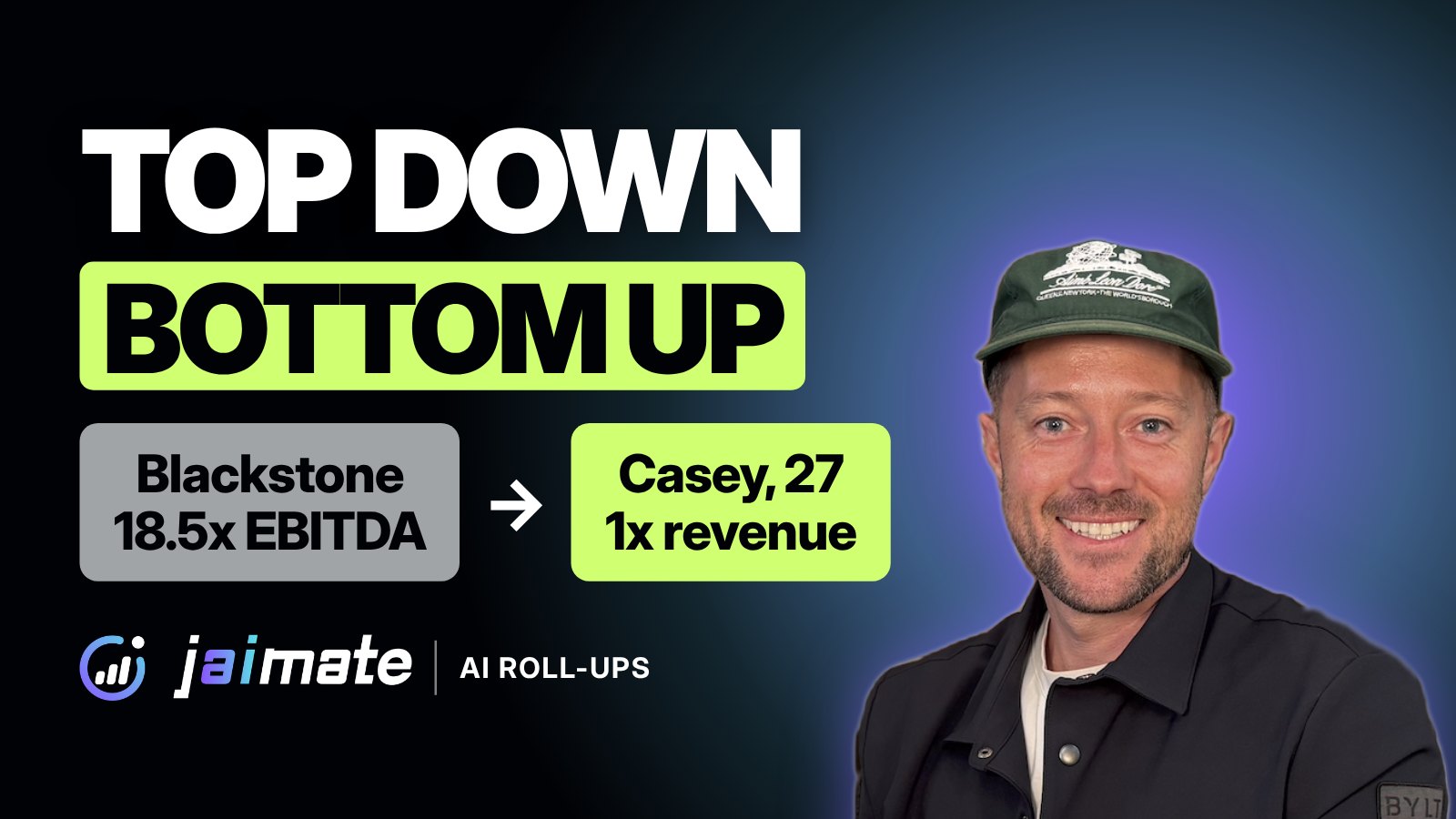
From the top, it's private equity. In February, Blackstone agreed to buy Champions Group, an Orange County home services platform built by buying local HVAC, plumbing and electrical companies, for about $2.5 billion. That's close to 18.5 times its estimated EBITDA. Coverage of the deal put the appeal down to steady demand, recurring revenue, and businesses "less susceptible to disruption from emerging technologies like artificial intelligence."
Then in September, Greg Isenberg posted The AI Roll-Up Playbook on X and it passed 1.6 million views. The idea is to buy a service business at a service business price, then rebuild how the work gets done with AI agents while the customers stay. He also wrote, "The biggest risk in any roll-up is buying faster than you can integrate."
Nearly every result on page one for "AI roll-up" is written for the buyer, or by someone selling to the buyer. I couldn't find one from an owner who has actually bought a trades business and rebuilt it.
The view from the bottom: three trades owners, three states
I've now recorded three episodes of Jaimate | AI for the Trades, with a roofer in San Jose, a drywall and paint contractor in Utah, and Casey in Colorado. None of them has a fund behind them, and all three do the rebuilding themselves. Casey sets up his agents on 6am mornings at the office. Jared does his job costing at midnight.
Price Foulger, Rally Roofing, San Jose
Price got his C-39 roofing license this summer and runs Rally Roofing with subs and no office staff. His estimates went from an hour and a half to a couple of minutes of his time. His books reconcile twice a day. "I don't have a bookkeeper. I don't, frankly, don't need one." The whole back office runs on one $99 a month subscription. The full breakdown is in AI for roofers in the Bay Area.
Jared Kotter, Canvas Drywall and Paint, Utah
Jared was a middle school teacher. In 2025, his first full year selling drywall, he sold about $1.8 million. He'll land around $2.7 million this year, and with his brother the drywall side does close to $5 million. "I make four times as much take-home money as I did as a teacher."
He built that number on permit data. Pull the new construction permits, call the builder, and open with "saw you're building at this address, do you have drywall lined up?"
AI shows up in the painting company he launched on August 1, which has done just over $300,000 in three months. When his estimator hits a surface they've never priced, like a metal shed, Jared types one line to Claude. It has their estimating software, the Sherwin-Williams product sheets and the painting trade association docs open, and the new service is built in about five minutes, while the estimator is still at the customer's kitchen table.
The drywall side, which his brother has run the same way for 15 years and which is doing well, is the before picture. Work orders get printed, priced in pen, scanned and emailed, then paper-clipped to the invoices and dropped in a box for the accountant. In Jared's words: "It's not is there a human in the loop, is there tech in the loop at all?"
Casey McDaniel, King Pest Solutions, Colorado
Casey sits in both camps. He's an acquirer, and he's rebuilding the back office with AI himself.
He doesn't look at EBITDA. He pays 1 to 1.5 times revenue and finances it over five to ten years. "If you've got half a million in revenue, I know how many techs I need for that." His fourth deal cost about $60,000 for a company that was losing money because the owner had stopped answering the phone. He sold the trucks it came with for about $30,000, and it's done roughly $85,000 in revenue in the 11 months since.
After he buys, about 10% of customers leave straight away, and another 10% over the next six months. By month 12, revenue is back where it was and margins are up a few points from denser routes, cheaper product and better software.
In the last few weeks he set up an agent that combs billing every day. It found customers getting serviced and never billed, and cards on file that weren't set to auto-pay. He'd planned to hire someone to run billing next year and has dropped the plan. The agent costs $20 a month.
He won't let AI answer his phones. He tested AI answering, said it was cheap and good, and passed. Half the time a customer who says termites has ants, and a $3,500 job a bot books becomes a wasted day for a $185 visit. Retention calls stay human too. "The last thing that a customer on the verge of canceling wants to do is argue back and forth with an AI answering machine."
And he finds deals the slow way. Every fall he emails 15 to 20 competitors: good year, happy holidays, call me if you ever think about selling. One said nothing for nearly two years, then emailed in August 2025 ready to sell. They closed about 13 days later.
Where top down and bottom up meet
Last week I spoke with an investor who's lining up to buy trades businesses in California. He wants to buy one, run it himself, then buy the next. He's looking at the same kind of business I work in, from the buyer's chair.
He runs three tests on every business he looks at. Is the owner the rainmaker? Does the owner have too many people reporting straight to them? Does the business depend on expertise that only lives in the owner's head? A yes to any of them and the business falls over the day the owner leaves.
The third one is where I spend my week. The landscaper I work with in Pacifica took seven days to get an estimate out, because his pricing lived in his head and on a notepad. It took five or six rounds of sitting with him to get that into a document his AI works from. Now a video of the site walk becomes a branded proposal in minutes, within about 1% of his own pricing.
He told me he doesn't care how a business makes its cash flow, and the more of it is automated and written down, the happier he is. "If all of a sudden a company goes from $1 million in cash flow to $2 million in cash flow, I'll pay for that."
Casey runs both halves in one company. He buys on revenue, keeps the crews, puts AI on billing and reporting, and keeps people on the phones.
The investor has a friend back east who buys businesses. After his first deal, the seller's competitors started calling to ask if he'd buy them too. Casey's fall email gets him those calls without waiting for them.
What this means for a Bay Area trades owner
If there's any chance you sell in the next five years, the most valuable AI work you can do is get what's in your head into writing: how you price, who you call first, the jobs you won't take and what you never promise on the phone. A buyer pays for that whether or not they ever say the word AI. It's also the first thing I do with every owner I work with, and I wrote up what to automate first if you want to start on your own.
And before you buy another piece of software, check your billing. Casey's billing agent costs $20 a month and found money he'd already earned and never collected.
Find Price on X, Jared on X and Casey on X.
FAQ
What is an AI roll-up? Buying several small service businesses in the same trade, keeping the customers and crews, and rebuilding the back office with AI. Greg Isenberg's post on X in September 2026 passed 1.6 million views.
Is private equity buying trades businesses? Yes. Blackstone's roughly $2.5 billion deal for Champions Group in February 2026, at close to 18.5 times EBITDA, is the biggest recent example. Small owner-run shops mostly sell to a local competitor instead. On two of Casey's deals the broker told him there were only two offers, his and one other.
How do small acquirers value a trades business? Casey prices pest control companies at 1 to 1.5 times revenue rather than on EBITDA. On deals under about $750,000 in revenue, the profit line mostly tells you how the current owner runs it, not what the business can do.
Does AI make a trades business worth more? To a buyer, yes, when it makes the business less dependent on the owner. Written pricing rules, automated billing and weekly reports are what a buyer can see and pay for.
Will AI replace the people in a trades business? Not in these three businesses. Casey dropped one future billing hire and kept every person on his phones. Price automated the permit paperwork, which he calls the task people dread, not the people doing it.
If you run a trade or a local business around Marin and want this working in your own office, I'm running a hands-on AI workshop on Wednesday, January 13, 3 to 5pm in Mill Valley, in partnership with the Larkspur Chamber. 25 seats. Bring your laptop and you leave with an automation live.